
What Exactly Is a Peptide?
Your Body's Healing Messengers
THE BASICS
What exactly is a peptide?
Peptides are short chains of amino acids — the same building blocks that make up proteins. Think of them as tiny biological keys that unlock specific processes in your body.
Simple analogy: If your cells are locks, peptides are the keys. Each peptide fits a specific receptor and tells your body to do something — heal, grow, regulate, or protect.
Your body already makes hundreds of its own peptides naturally
Therapeutic peptides mimic or amplify these natural signals
They're smaller and more targeted than traditional drugs
Most are given as injections, nasal sprays, or topical creams
HOW THEY WORK
Peptides in action — step by step
1) Peptides enter your body -Delivered via injection, cream, or nasal spray — absorbed quickly into your bloodstream or tissue.
2) Finds its target receptors - Like a GPS, each peptide travels directly to its receptor on specific cells, aiming for minimal off-target effect.
3) Sends a healing signal- Triggers a cascade of biological responses — recruiting repair cells, calming inflammation, or stimulating growth factors.
4) Your body does the healing- The peptide is intended to support your body's own natural repair systems — assisting the process rather than replacing it.
How is this different from a typical medication?
•They work with the body, not against a symptom.Most conventional drugs block or suppress a pathway (a receptor, an enzyme, a pain signal). Peptides generally do the opposite — they activate a process your body already has the machinery for.
•We have receptors for them.Peptide receptors already exist throughout the body because these are naturally occurring signaling molecules — this is part of why they tend to be well tolerated.
•The goal is to support healing or balance, not just mask a symptom.Rather than covering up a symptom, the aim is to support the underlying repair or regulatory process until it no longer needs support.
•They're intended for short-term use.Peptide protocols are typically used for a defined period to help resolve an injury, an immune challenge, or an imbalance — not as a long-term crutch the body comes to depend on.
PEPTIDE SPOTLIGHT
Peptides you'll hear about most
Here's a closer look at some of the most-discussed peptides in regenerative, immune, and metabolic health.
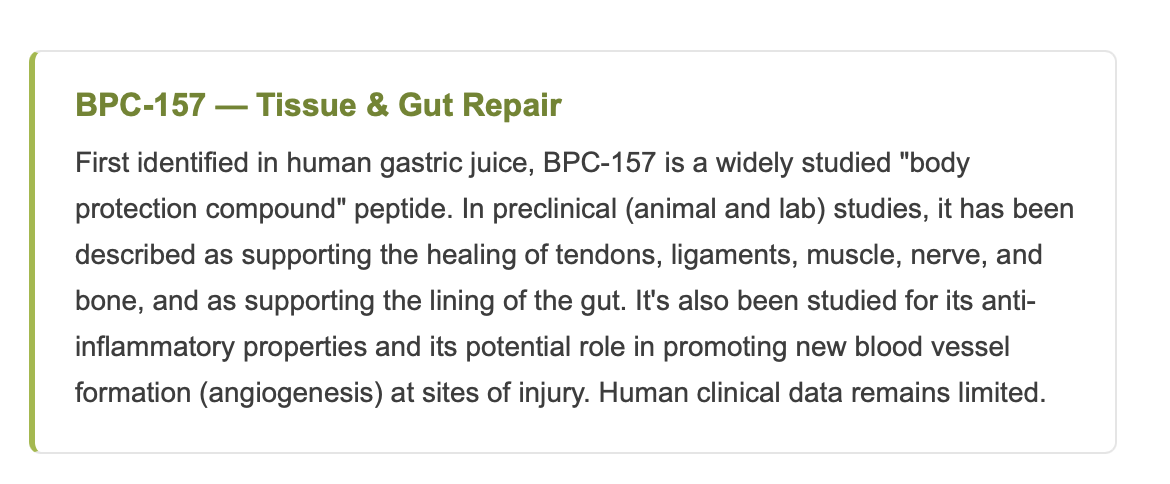
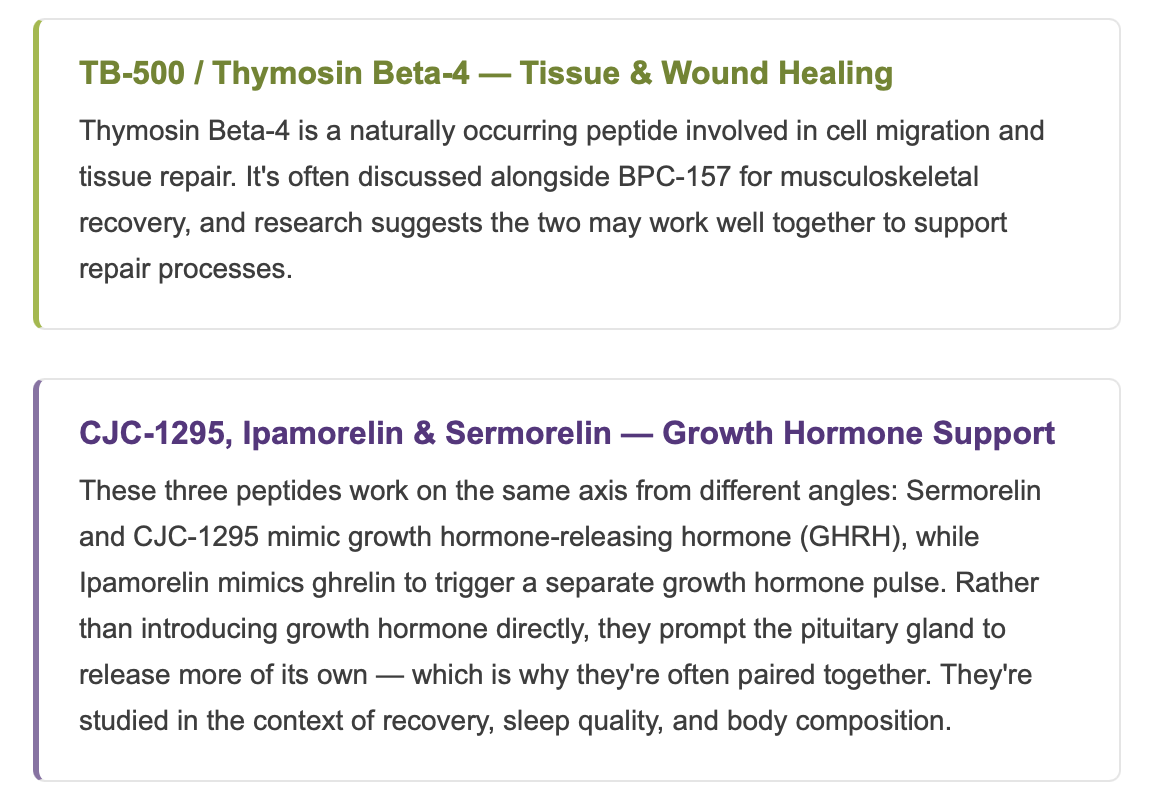
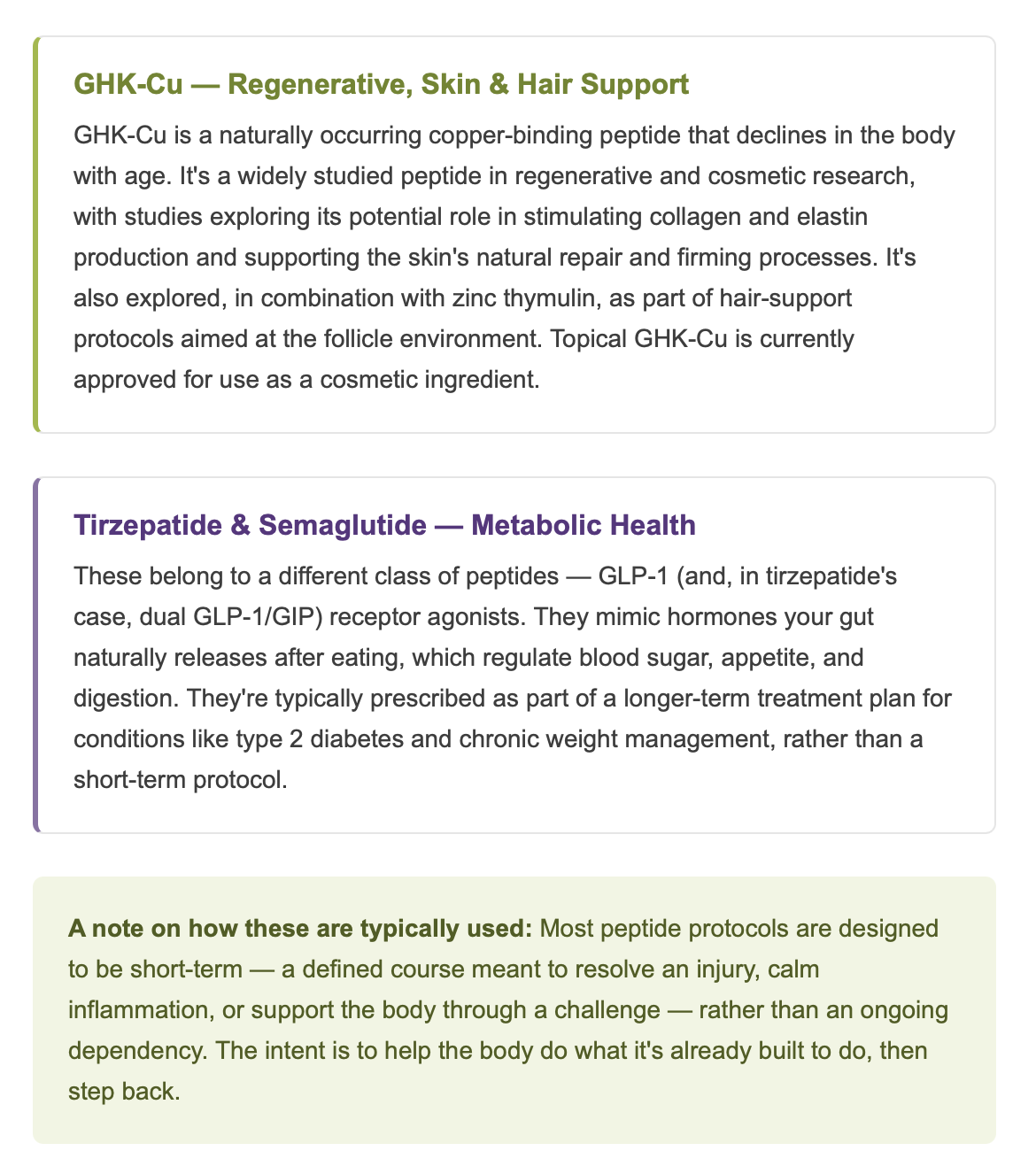
Is it legal to get these? It depends how.
• | Off-label:A doctor can legally prescribe an FDA-approved drug for a use it wasn't originally approved for — for example, semaglutide was prescribed off-label for weight loss before it received its own FDA-approved weight-management indication (Wegovy®). |
• | Compounded:An unapproved peptide can be legally prepared by a licensed compounding pharmacy for a specific patient, with a valid prescription — but only while it's on the FDA's permitted list for compounding. This is legal, but it is not FDA approval. |
• | Online, no prescription:Peptides sold online as "research use only," without a prescription, aren't a legal path to a prescription medication — and they come with no guarantee of purity, sterility, or even correct contents. |
Peptide therapy should always be discussed with, and supervised by, a qualified healthcare provider who can evaluate whether it's appropriate for your individual health history — and who sources through a licensed compounding pharmacy.

A note on FDA Approval
What FDA-approved actually means: A drug is FDA-approved when a manufacturer has taken it through the agency's full review process — including controlled human clinical trials — to demonstrate it's safe and effective for a specific use, and the agency has signed off on how it's manufactured and labeled. Approval is always tied to a specific product and a specific indication, not to a peptide in general. Compounded peptides, even when legal to prepare, are not FDA-approved drugs — they're prescription preparations made by a licensed pharmacy without that same trial-and-review process.
Commonly discussed FDA-approved peptides:
Semaglutide, Tirzepatide, Liraglutide, Insulin, Glucagon, Tesamorelin, Sermorelin, Somatropin, Oxytocin
Peptides currently under FDA review for compounding access:In 2023, the FDA restricted a group of widely used peptides from pharmacy compounding, citing safety and data concerns. That decision is now under formal re-evaluation. As of this writing:
Scheduled for FDA advisory committee review, July 2026 |
BPC-157 · TB-500 (Thymosin Beta-4 fragment) · KPV · MOTS-c · Semax · Epitalon · DSIP (also called emideltide) |
Under a separate, accelerated review |
CJC-1295 · Ipamorelin · AOD-9604 · Thymosin Alpha-1 · Kisspeptin · Ibutamoren (MK-677) |
